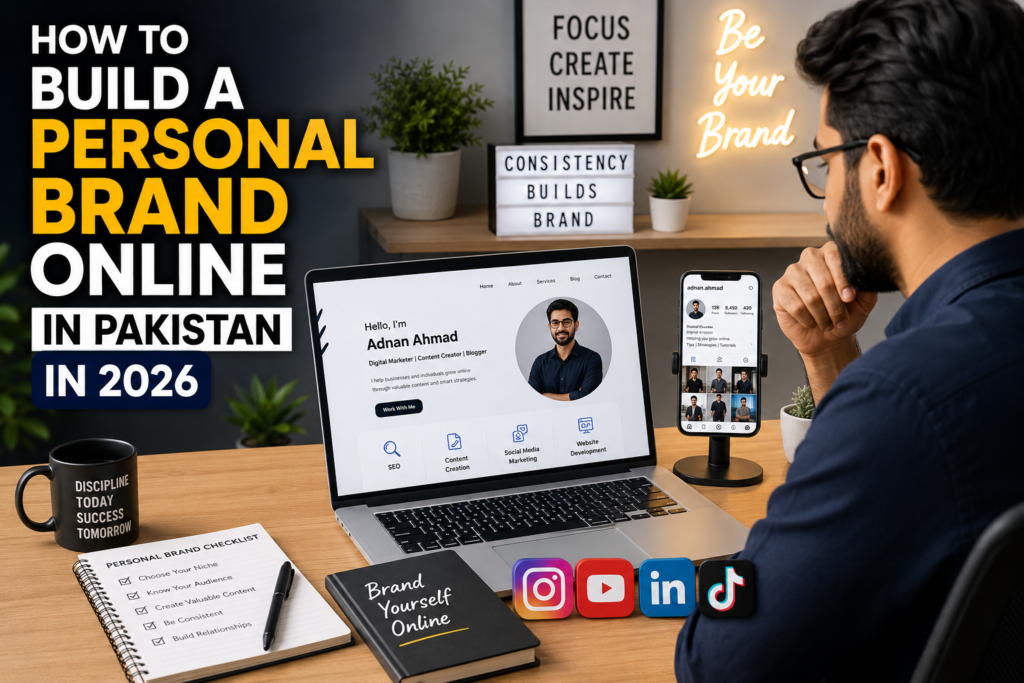
Why Your Personal Brand Matters More Than Your Portfolio in 2026
Clients in 2026 do not hire the freelancer with the longest CV. They hire the freelancer they already trust — and trust is built in public, long before a job is ever posted. A personal brand is simply that trust, made visible: a clear niche, proof of your work, and a consistent presence in the places your clients actually look.
For Pakistani freelancers, this matters more than it does for most. You are competing in global marketplaces where thousands of profiles look identical. A strong personal brand is what makes a client in London or Toronto pick your profile over a cheaper one. It is also what brings clients to you, instead of you chasing every job post.
The numbers back this up. An iHire survey of 2,250 job candidates in January 2026 found that 27.9% named establishing credibility and a strong personal brand as one of their top challenges in finding work. LinkedIn now has 1.3 billion members and drives around 80% of B2B social-media leads. And 93% of freelancers find clients through online platforms or digital channels, according to Upwork’s 2024 data. The clients are already online, looking. The question is whether they can find you — and whether what they find makes them want to hire you.
This guide shows you how to build that brand from scratch in Pakistan: pick one niche, prove your value in public, post consistently, and turn attention into enquiries. No follower-growth promises, no shortcuts — just a system that works.
Step 1: Pick One Niche and Own It
A personal brand that tries to cover everything says nothing. “I do graphic design, video editing, data entry and social media” tells a client you are available. “I design conversion-focused landing pages for SaaS startups” tells a client you are the answer to their specific problem.
Choosing a niche feels like giving up work. In practice, it does the opposite. Specialists charge more, get remembered more easily, and get referred more often — because a referral only works when the referrer can describe you in one sentence. This is the same specialization principle at the heart of our 2026 playbook for new Pakistani freelancers: one narrow service, done visibly well, beats five services done quietly.
How to choose: start from what you can already do, then narrow by who pays for it. A writer who knows e-commerce should not pitch “content writing” — they should pitch “product descriptions and email copy for Shopify stores.” A designer who understands real estate should pitch “property listing graphics for agents in Lahore and Karachi.” Your niche is the overlap of your skill, a paying market, and a topic you can talk about every week without running dry.
Write your niche down in one sentence and use it everywhere — your LinkedIn headline, your Upwork title, your Instagram bio. Same words, same promise, every platform. Repetition is what makes a brand stick.
Step 2: Build Proof Before You Build an Audience
Followers are a vanity metric. Proof is what closes clients. Before you worry about reach, create three pieces of proof that show a result, not just a skill:
- A before-and-after: a client’s old landing page vs your redesign, with the change in sign-ups or enquiries.
- A process post: how you solved a real problem, step by step, with screenshots.
- A testimonial with numbers: a client’s words plus one measurable outcome — “our email open rate rose from 18% to 31% in six weeks.”
If you have no clients yet, create proof anyway. Redesign a well-known Pakistani brand’s homepage as a concept project and explain your choices. Audit a real website’s SEO and publish the findings. Write a sample email sequence for a local business and show the thinking behind it. Spec work with real reasoning is still proof — what clients judge is your thinking, not who paid for it.
Keep every proof piece on a single page you control. Our guide to building a proof-of-work portfolio website walks through exactly how to structure it: three pieces, each with a result, each linked from your profiles. Your social posts then point at this page again and again.
Step 3: Choose Two Channels and Show Up Every Week
You do not need to be everywhere. You need to be consistent somewhere your clients already are. For most Pakistani freelancers, that means LinkedIn first and one more channel second — Instagram for visual work, X for writing and tech, YouTube for teaching.
LinkedIn deserves the first slot because it is where hiring decisions happen. Our LinkedIn guide for Pakistani freelancers covers the profile setup and outreach in detail — headline, featured work, and a message structure that actually gets replies. The brand layer on top of that is simple: post two or three times a week, and every post should do one of three things — teach something, show proof, or share a lesson from real work.
A practical weekly rhythm:
| Day | Post type | Example |
|---|---|---|
| Monday | Teach | One tip from your niche, explained in 150 words |
| Wednesday | Prove | A result, a screenshot, a before-and-after |
| Friday | Story | A lesson from a real project — what went wrong, what you changed |
Consistency beats volume. One useful post a week for six months builds more trust than thirty posts in one week followed by silence. Clients check your recent activity before replying to a proposal — a profile that posted last week looks alive; a profile silent for three months looks abandoned.
Step 4: Turn Content Into Conversations, Then Into Enquiries
Posting is only half the job. A personal brand grows when people talk back, and conversations are where enquiries start. Spend fifteen minutes a day doing three things: reply to every comment on your own posts, comment thoughtfully on posts by people in your niche, and send one genuine message to someone whose work you admire — no pitch, just a specific compliment or question.
When someone does enquire, make it easy for them. Your profiles should answer three questions in ten seconds: what you do, who you do it for, and how to contact you. A pinned post or featured section with your best proof piece, your niche sentence, and a clear call to action (“DM me ‘audit’ for a free homepage review”) turns passive readers into active enquiries.
Track what works. Each month, note which posts brought profile views, messages, or enquiries, and do more of that type. A simple spreadsheet with date, topic, post type, and result is enough. Over time, you will see a pattern — usually, proof posts and honest lessons outperform generic tips by a wide margin.
A Pakistan-Specific Example: From Invisible to Inbound
Consider an illustrative example: a content writer based in Lahore who spent a year applying to Upwork jobs with a generic profile and no replies. In early 2026 she changed strategy. She picked one niche — email copy for e-commerce stores — and posted on LinkedIn three times a week: teardowns of real store emails, a rewritten welcome email with her reasoning, and weekly lessons from her own learning.
Within three months, store owners in her comments were asking for her rates. Within six months, two of her first clients came from LinkedIn inbound messages, not from job applications — and she could charge more, because the clients had already seen her thinking before they ever spoke to her. Nothing about her writing skill changed in those six months. What changed was that her skill became visible.
This is an illustrative example, not a guarantee — but the mechanism is real, and it is repeatable. Visibility plus proof, repeated weekly, is what turns a freelancer from one of thousands into the obvious choice.
The Numbers Behind the Strategy
| Data point | Figure | Source |
|---|---|---|
| Candidates citing personal brand / credibility as a top challenge | 27.9% | iHire survey, Jan 2026 (2,250 candidates) |
| LinkedIn members worldwide | 1.3 billion | LinkedIn, 2026 |
| Share of B2B social-media leads from LinkedIn | ~80% | LinkedIn data |
| Freelancers finding clients via online platforms / digital channels | 93% | Upwork, 2024 |
| Pakistani freelancers’ foreign-exchange earnings, FY2025-26 | $1.76 billion | State Bank of Pakistan, July 2026 |
The last row matters because it frames the opportunity: Pakistan’s freelance economy is growing fast, and the freelancers winning the best work are the ones clients can find and trust before the first message. Your brand is how you join that group.
Common Mistakes That Kill a Personal Brand
- Copying other creators’ posts: reposting someone else’s content without adding your own thinking teaches your audience to follow the original, not you.
- Changing niches every month: a brand needs repetition. If your audience cannot describe what you do in one sentence, they cannot refer you.
- Posting only when you need work: bursts of activity followed by silence signal desperation, not expertise. Steady beats frantic.
- Hiding your rates and process: clients trust freelancers who explain how they work. Share your process openly; keep only the price negotiation private.
- Ignoring comments: every unanswered comment is a conversation you chose not to have — and conversations are where clients come from.
Your 30-Day Personal Brand Starter Plan
- Days 1–3: Write your one-sentence niche and update your LinkedIn headline, Upwork title and bio to match.
- Days 4–10: Create your three proof pieces and put them on your portfolio page.
- Days 11–30: Post three times a week using the Monday–Wednesday–Friday rhythm above. Reply to every comment. Message one person in your niche each day.
- Day 30: Review the month: which posts brought views and messages? Double down on that type next month.
Thirty days will not make you famous. It will make you visible, credible, and — for the first time — findable by the clients who need exactly what you do.
Premium Digital Products
Want ready-made tools to grow faster? These digital products are built for creators and freelancers:
- AI Prompt Mega Bundle ($29.99) — hundreds of ready-to-use prompts for content, marketing and client work.
- Creator Growth Bundle ($19.99) — templates and guides to grow your audience and turn it into income.
- Content Creator Planner 2026 ($12.99) — plan your posts, track your growth and stay consistent all year.
Frequently Asked Questions
How long does it take to build a personal brand as a freelancer?
Expect three to six months of consistent weekly posting before inbound enquiries become regular. The first month builds your proof and your habit; the second and third build recognition. There is no shortcut — but the compounding effect means month six is usually far better than month one.
Do I need a large following to get clients from my personal brand?
No. A few hundred of the right people — store owners, marketing managers, agency founders in your niche — are worth more than ten thousand random followers. Clients hire from trust and proof, not from follower counts.
Should Pakistani freelancers brand themselves as Pakistani?
Your location is a fact, not a limitation. Many clients value Pakistani freelancers for their English skills, time-zone overlap with the Gulf and Europe, and competitive rates. Be honest about where you are based and let your proof do the convincing.
Which platform should I start with?
LinkedIn, for almost every service niche — it is where hiring managers and business owners search. Add a second channel only once your LinkedIn rhythm is steady: Instagram for visual work, X for writing and tech, YouTube for teaching.
Can a personal brand work if I am just starting out with no clients?
Yes. Create proof from spec work — redesigns, audits, sample projects with real reasoning — and post your learning publicly. Clients judge your thinking, not your client list.
How often should I post?
Two to three times a week is enough, if every post teaches, proves or tells a real story. Consistency over months matters far more than daily posting for two weeks and then disappearing.
Conclusion
A personal brand is not about becoming an influencer. It is about becoming findable, credible and memorable to the small group of people who hire for your skill. Pick one niche, prove your value in public, show up every week, and turn the conversations your content starts into enquiries. In a freelance market as large and fast-growing as Pakistan’s, the freelancers who win are rarely the cheapest — they are the ones clients already trust before the first message. Start your thirty days today, and let your work speak where you are not in the room.
Follow Us
- YouTube: AI Tool Hunter
- TikTok: @aitoolhunter2
- Facebook: AI Tool Hunter