Introduction: the client channel most Pakistani freelancers ignore
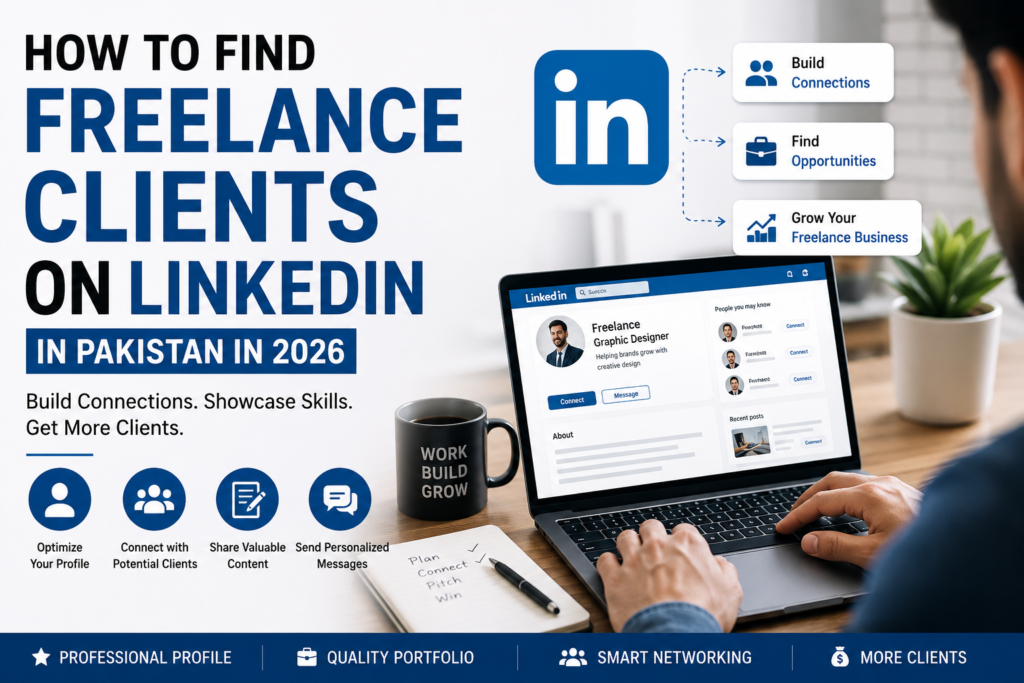
Most Pakistani freelancers start on Fiverr or Upwork — those platforms bring clients to you, but also heavy competition. LinkedIn works the other way round: you go to the client, with your name, your face and your work attached.
That difference matters. On a marketplace, a client compares prices. On LinkedIn, a client judges a person. If your profile says who you help and shows proof you can do the work, a short, respectful message can open a conversation a marketplace bid never would.
If you are still choosing your service, read our 2026 playbook on specialization and proof of work first — LinkedIn works best with one clear service, not five vague ones.
Why LinkedIn works differently from Fiverr and Upwork
On Fiverr, clients search for a gig. On Upwork, clients post a job and read proposals. On LinkedIn, hiring happens through relationships: a founder sees your post, a manager notices your comment, or a colleague recommends you.
That means patience is part of the method. LinkedIn rarely produces a client in a day, but its clients often return, refer others and pay for ongoing work. It also means your profile is your landing page: before anyone replies, they will open it. If it looks unfinished, the conversation ends before it starts. The platform suits services businesses buy directly: writing, social media management, design, video editing, virtual assistance and bookkeeping.
Step 1: Build a profile that says who you help
Forget a headline that just says “Freelancer” or “Open to work”. A client should understand, in five seconds, what you do and for whom. Use this formula: I help [who] get [result] with [service].
For example: “I help e-commerce brands in Pakistan grow on Instagram with reels and product content.” That is better than “Graphic Designer | Freelancer” because it names the buyer and the outcome.
Then fix the rest of the profile in this order:
- Photo and banner: a clear headshot and a banner repeating your service in plain words.
- About section: three short paragraphs — who you help, what you have done, and what to do next, ending with “Send me a message if you need help with your next launch.”
- Experience: list freelance work as real roles, e.g. “Managed Instagram for a Karachi clothing brand, 3 posts per week.”
- Featured section: pin your three best pieces of work or a short case study, so a visitor sees proof at once.
Do not lie about clients, results or qualifications. One honest case study earns more trust than five impressive-sounding claims a client cannot verify.
Step 2: Turn your work into proof posts
Clients hire evidence, not a list of skills. You do not need a big audience — just a repeatable pattern of two posts a week:
- A result post: a before-and-after, a small win, or a lesson from a real project. Keep client names out unless you have permission.
- A how-to post: teach one small thing your buyer cares about, such as how to write a product caption that sells, or how to plan a week of posts in one hour.
Keep each post short, start with one clear line, and end with a question or an invitation to message you. Never copy viral posts word for word — clients spot recycled content. If you have no paid work yet, create a sample project for a made-up brand and label it as a sample. Our guide to getting your first client on Upwork from Pakistan covers portfolio basics that apply here too.
Step 3: Outreach that gets replies instead of being ignored
Outreach fails most often because the message is about the sender, not the receiver. A long message listing your services, sent to fifty people at once, reads like spam. A short, specific message to the right person reads like a real introduction.
Use this structure, and keep the whole message under 100 words:
- One specific line about them. Mention a post they wrote, a product they launched, or a problem their business clearly has. Generic praise (“I loved your profile”) does not count.
- One line about the result you can help with. Tie it to their business, not your skills: “I help clothing brands turn product photos into a week of reels.”
- One low-pressure question. “Would it be useful if I sent two reel ideas for your new collection?” is easier to answer than “Can we schedule a call?”
Follow up politely, twice at most: once after four to five days, and once more a week later. After that, stop. Aim for ten thoughtful messages a week rather than a hundred copy-paste ones, and track replies in a spreadsheet.
Target founders, marketing managers and small business owners who actually buy your service, and check their business is real first. Our guide to freelance scams in Pakistan explains the red flags — advance-fee charges, unpaid “test” work that is really the deliverable, and pressure to move off-platform — which apply on LinkedIn too.
Common mistakes to avoid
- Posting only “available for work” graphics. Clients want thinking and results, not announcements.
- Connecting without a note, then pitching instantly. Let the person accept first.
- Hiding behind a company name. People hire people — use your own name and photo.
- Quoting a price in the first message. Price comes after you understand the work; see today’s guide to pricing your first freelance service in PKR.
- Disappearing for months. Two posts a week keeps you visible.
A realistic 30-day plan
Week 1: rewrite your headline, About and Featured sections; publish one how-to post. Week 2: publish two posts and send ten tailored connection requests — no pitches yet. Week 3: send ten outreach messages using the structure above. Week 4: publish a result post, follow up once, and review what got replies. Double down on what worked.
Thirty days may not bring a client on its own, but it will leave you with a profile worth showing, a small body of proof, and real conversations started.
Frequently asked questions
Do I need LinkedIn Premium to get clients?
No. A clear profile, proof posts and thoughtful outreach work on a free account. Consider Premium only after free outreach is already getting replies.
How many connections should I aim for?
Quality beats quantity. A few hundred relevant connections — owners and managers in your niche — are worth more than thousands of random adds.
What if I have no portfolio yet?
Build one: three sample projects for imaginary clients, labelled as samples, with the best pinned in your Featured section. Honest samples prove skill; fake client names do not.
Conclusion: be findable, be believable, be specific
LinkedIn rewards freelancers who are easy to understand and easy to trust. Fix your headline, pin proof where visitors can see it, post twice a week, and send short, specific messages to the right people. Do that for a month, and you will have a channel of your own, where clients come to you because of your work — not just your price.
Start today: rewrite your headline, pin one piece of proof, and send your first five thoughtful messages this week.
Premium Digital Products
If you want ready-made tools to support your freelance work, these digital products from our store may help:
- Freelancer Business Kit ($14.99) — templates and systems for running your freelance business properly.
- 100 Viral Content Prompts ($9.99) — prompt ideas to keep your LinkedIn and social content consistent.
- Creator Growth Bundle ($19.99) — growth resources for creators building an audience alongside client work.
Follow Us
- YouTube: AI Tool Hunter
- TikTok: @aitoolhunter2
- Facebook: AI Tool Hunter