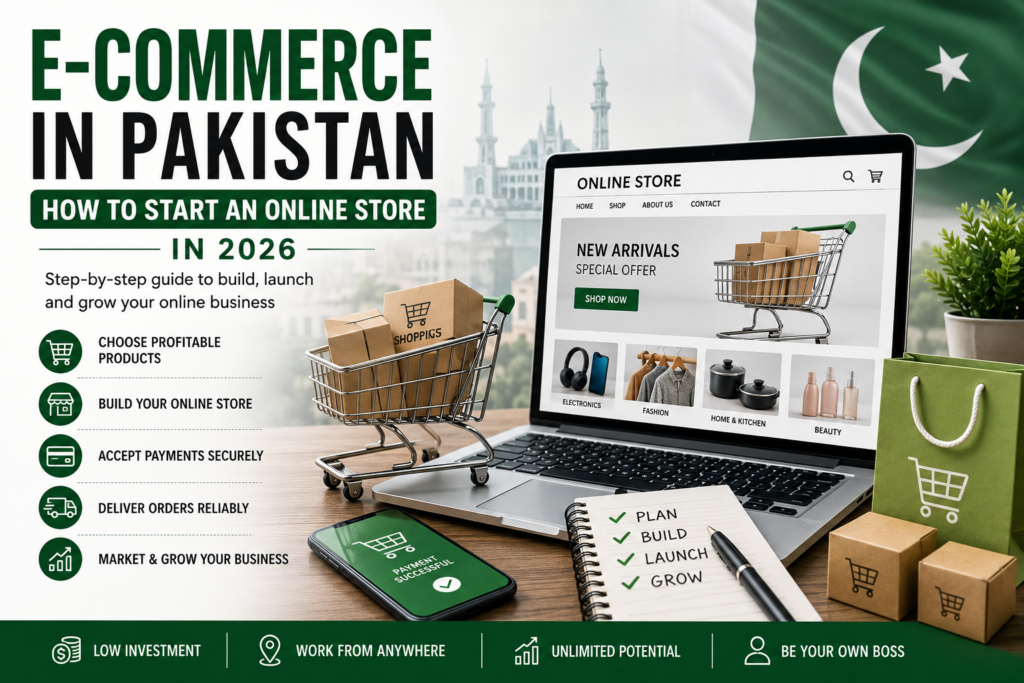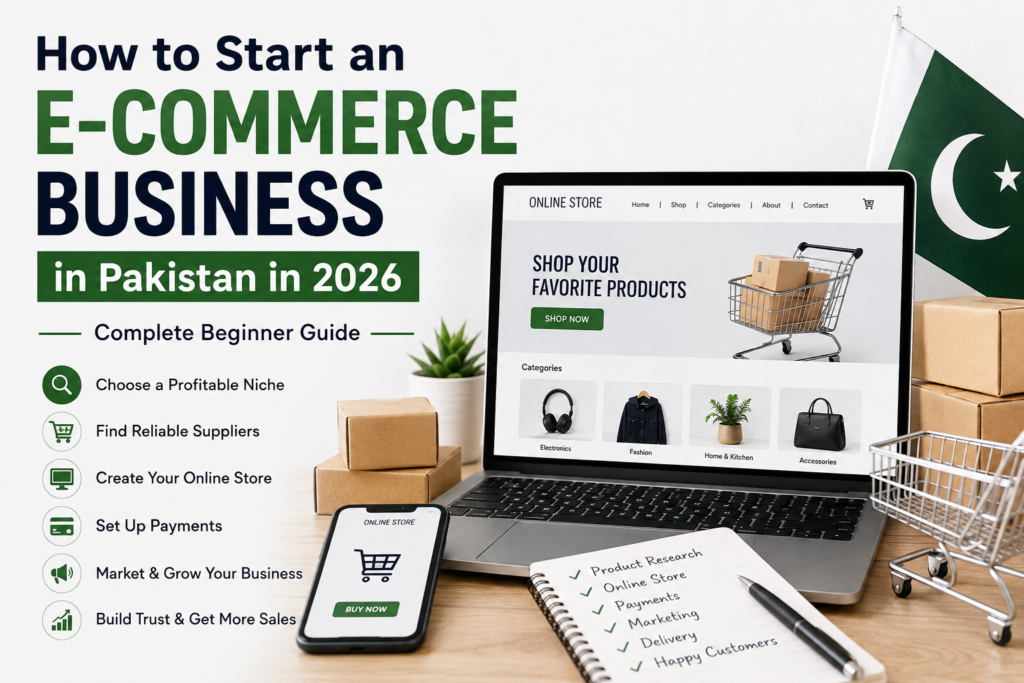
Starting an e-commerce business in Pakistan has become an attractive opportunity for beginners, freelancers, students, and small business owners. You do not necessarily need a physical shop to start selling products. With the right product, online store, marketing strategy, and reliable delivery system, you can build an online business from Pakistan and potentially reach customers across the country.
In this complete guide, you will learn how to start an e-commerce business in Pakistan in 2026, how to choose products, create an online store, receive payments, market your products, and avoid common beginner mistakes.E-commerce business in Pakistan ✅
What Is E-Commerce?
E-commerce means buying and selling products or services through the internet.
Instead of depending only on a physical shop, an e-commerce business allows customers to discover products online, place orders, and receive their purchases through delivery services.
Common e-commerce models include:
- Selling your own products
- Buying products wholesale and selling them online
- Dropshipping
- Print-on-demand
- Selling handmade products
- Selling digital products
- Building a niche online store
The best model depends on your budget, skills, product availability, and target customers.
Why Start an E-Commerce Business in Pakistan in 2026?
Why Start an E-Commerce Business in Pakistan in 2026?
Online shopping continues to create opportunities for businesses that understand what customers want and provide a convenient buying experience.
One major advantage is that you can start relatively small. Instead of renting an expensive shop, you can test a product online before investing heavily in inventory.E-commerce business in Pakistan ✅
E-commerce can also allow you to:
- Reach customers outside your local city
- Test different products quickly
- Build a recognizable brand
- Sell through multiple online channels
- Start with limited inventory
- Scale a successful product over time
However, e-commerce is not a guaranteed way to make money. Success depends on product selection, pricing, customer service, marketing, delivery, and consistent improvement.
Step 1: Choose the Right E-Commerce Niche
The first major decision is choosing a niche.
A niche is a specific category of products you want to sell. Instead of trying to sell everything, beginners should consider starting with a focused category. E-commerce business in Pakistan ✅
Examples include:
- Mobile accessories
- Home and kitchen products
- Fashion accessories
- Fitness accessories
- Beauty accessories
- Baby products
- Office and study products
- Car accessories
- Pet products
A good niche should have enough customer demand while allowing you to differentiate your store from competitors.
Do not choose a product simply because it is trending. Research whether people are actually searching for it, whether competitors are selling it successfully, and whether you can make a reasonable profit after all expenses.
Step 2: Research Products Before Buying Inventory
Product research is one of the most important parts of starting an e-commerce business.
Before buying stock, investigate:
- Customer demand
- Competitor prices
- Product quality
- Shipping cost
- Return possibilities
- Profit margin
- Product size and weight
- Customer reviews
- Potential for repeat purchases
For example, suppose you find a product that costs Rs. 1,000 from a supplier and plan to sell it for Rs. 1,800.
Your actual profit is not automatically Rs. 800.
You may also have expenses such as:
- Packaging
- Delivery
- Payment processing
- Advertising
- Returns
- Discounts
- Damaged or rejected orders
Calculate your complete cost before deciding your selling price.
Step 3: Find Reliable Suppliers
Once you select a product, find a reliable supplier.
You can explore:
- Local wholesalers
- Manufacturers
- Distributors
- Importers
- B2B marketplaces
- Local markets
Do not immediately purchase a large quantity from an unknown supplier.
First, order samples or a small quantity when possible. Check:
- Product quality
- Packaging
- Supplier communication
- Delivery time
- Defective items
- Actual product dimensions
- Product consistency
A cheap supplier is not always the best supplier. A reliable supplier who maintains quality can be more valuable for a long-term business.
Step 4: Decide Between Inventory and Dropshipping
You generally have two common options.
Option 1: Hold Your Own Inventory
You purchase products in advance and keep them with you.
Advantages:
- Better control over quality
- Faster order processing
- Easier branding and packaging
- More control over customer experience
Disadvantages:
- Requires upfront investment
- Unsold inventory can become a problem
- Storage is required
Option 2: Dropshipping
With dropshipping, you advertise products without keeping all inventory yourself. When a customer places an order, the supplier fulfills the order according to your arrangement.
Advantages:
- Lower initial inventory requirement
- Easier product testing
- Less storage requirement
Disadvantages:
- Less control over fulfillment
- Supplier reliability becomes extremely important
- Delivery problems can affect your brand
- Profit margins may be lower
For beginners, testing products carefully before scaling is usually more important than choosing the model that sounds easiest.
Step 5: Create Your Online Store
Your online store is where customers learn about your products and place orders.
A professional store should include:
- Homepage
- Product pages
- About page
- Contact page
- Shipping information
- Return/refund policy
- Privacy policy
- Terms and conditions
- FAQ section
Each product page should clearly explain:
- Product name
- Main benefits
- Features
- Price
- Available variants
- Delivery information
- Return information
- High-quality images
Avoid copying generic supplier descriptions. Write useful, customer-focused descriptions that explain why the product is valuable.
Step 6: Optimize Your Product Pages for SEO
SEO can help your store appear when people search for products on Google.
Use your primary keyword naturally in:
- Product title
- URL
- Introduction
- H2 headings where appropriate
- Meta title
- Meta description
- Image alt text
- Product description
Do not repeatedly insert the same keyword just to increase keyword density.
Google’s goal is to provide useful results to users, so your product page should answer the customer’s questions clearly.
For example, instead of writing:
Cheap mobile accessories Pakistan
repeatedly throughout the page, create useful content such as:
Best Mobile Accessories in Pakistan for Everyday Use
Then explain compatibility, quality, features, pricing, delivery, and common customer questions.
Step 7: Choose Your Payment Method
Payment is an important part of the e-commerce customer journey.
Depending on your business model and available providers, you may offer options such as:
- Cash on delivery
- Bank transfer
- Card payments
- Digital payment methods
Make the payment process simple and trustworthy.
Clearly communicate what happens after an order is placed. Customers should know when they can expect delivery and how they can contact you.
Step 8: Set Up Reliable Delivery
A good product can still result in unhappy customers if delivery is poor.
Before launching your store, understand:
- Delivery charges
- Estimated delivery time
- Serviceable locations
- Return handling
- Cash-on-delivery procedures
- Tracking availability
Keep your shipping policy visible on the website.
Never promise extremely fast delivery unless you can consistently meet that promise.
Step 9: Use Social Media Marketing
Social media can be extremely useful for promoting an e-commerce store.
You can create content for platforms such as:
- TikTok
- YouTube
Instead of only posting advertisements, create content that demonstrates your product.
For example:
- Product demonstrations
- Before-and-after examples
- Tutorials
- Problem-solving videos
- Customer reviews
- Comparison videos
- Frequently asked questions
Short-form video can be especially useful for demonstrating products because customers can quickly understand how the product works.
Step 10: Learn Basic Paid Advertising
Organic traffic can take time. Paid advertising can help businesses test products and reach targeted audiences more quickly.
However, do not start by spending a large amount of money.
Start with a controlled budget and measure:
- Click-through rate
- Cost per click
- Add-to-cart rate
- Conversion rate
- Cost per purchase
- Average order value
- Overall profit
The most important number is not simply how many people clicked your advertisement. It is whether those visitors generated profitable sales.
Step 11: Build Trust Before Trying to Scale
Trust is one of the biggest factors in online shopping.
A new store should make customers feel comfortable before asking them to place an order.
You can build trust through:
- Clear product information
- Real product photographs
- Transparent pricing
- Visible contact information
- Clear return policies
- Customer reviews
- Professional website design
- Fast customer support
Avoid fake reviews, misleading claims, fake discounts, or unrealistic promises.
A trustworthy business has a better chance of generating repeat customers.
Common E-Commerce Mistakes Beginners Should Avoid
Many beginners make the same mistakes when starting an online store.
- Choosing Products Without Research
A product may look profitable but have very little real demand.
- Buying Too Much Inventory
Do not invest heavily before testing whether customers actually want the product.
- Ignoring Profit Margins
Revenue is not the same as profit.
- Using Poor Product Images
Customers cannot physically inspect your product, so images are extremely important.
- Ignoring Customer Service
Slow replies and poor communication can damage your reputation.
- Depending on One Marketing Channel
Build multiple traffic sources over time instead of depending completely on one platform.
- Copying Competitors
Research competitors, but build your own brand, content, offers, and customer experience.
How Much Money Do You Need to Start E-Commerce in Pakistan?
There is no single fixed amount required to start an e-commerce business.
Your starting budget depends on your business model.
A small business may begin with limited inventory and basic marketing, while a larger operation may require significantly more capital for stock, branding, website development, packaging, and advertising.
A smart approach is to start with a manageable budget, test your idea, measure results, and reinvest profits rather than spending everything at the beginning.
E-Commerce SEO Strategy for Long-Term Growth
If you want your e-commerce website to receive traffic from Google, think beyond individual product pages.
Create helpful content around your niche.
For example, if you sell mobile accessories, you could publish articles such as:
- Best Mobile Accessories for Students
- How to Choose the Right Power Bank
- Best Accessories for Android Phones
- USB-C vs Lightning: What Is the Difference?
- How to Protect Your Phone Battery
These articles can attract informational searches and internally link to relevant product pages.
This creates a stronger content ecosystem around your online store.
Final Thoughts
Starting an e-commerce business in Pakistan in 2026 can be a practical online business opportunity, but it should be approached as a real business rather than a quick-money scheme.
Choose a focused niche, research products carefully, work with reliable suppliers, calculate your actual profit, create a trustworthy online store, and invest in SEO and marketing.
Most importantly, start small, learn from customer feedback, and improve your business based on real data.
E-commerce success usually comes from consistent execution rather than finding one “magic” product.
Frequently Asked Questions
A website is not always required at the beginning, but having your own professional website can provide more control over branding, customer experience, SEO, and long-term growth.
Which products are best for e-commerce in Pakistan?
There is no universally best product. Look for products with genuine demand, manageable shipping costs, acceptable competition, good margins, and a clear customer problem or need.
How can I get customers for my online store?
You can use SEO, social media content, influencer marketing, email marketing, and paid advertising. The best strategy depends on your niche and target audience. E-commerce business in Pakistan ✅
How long does it take to make money from e-commerce?
There is no guaranteed timeline. Some stores may generate sales relatively quickly, while others require months of testing, marketing, SEO, and product improvement.
Is e-commerce better than a physical shop?
Both models have advantages. E-commerce can reduce some traditional overheads and allow you to reach customers beyond your local area, while physical stores provide direct customer interaction. The right choice depends on your business.
Conclusion
The opportunity to build an e-commerce business in Pakistan is bigger than simply putting products on a website. A successful online business combines product research, competitive pricing, reliable fulfillment, strong customer service, effective marketing, and search-engine optimization.
If you build these foundations properly and continuously improve based on real customer data, your online store can develop from a small experiment into a sustainable business .E-commerce business in Pakistan ✅