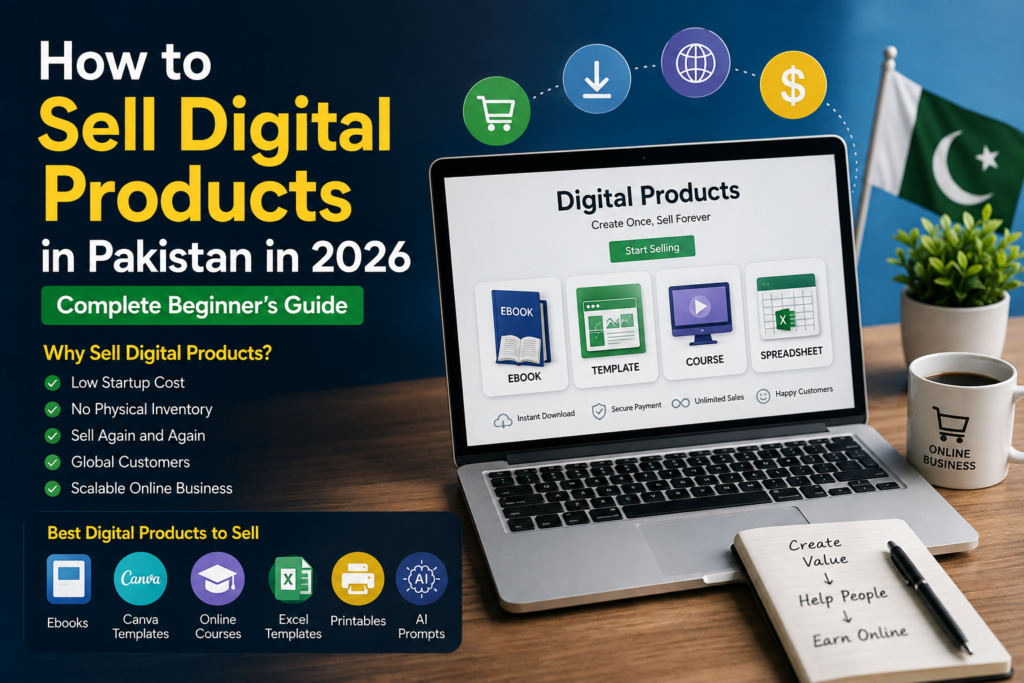
If you know how to do something well — teach English, use Excel, cook desi food, fix a phone, design with Canva — you already own the raw material for an online course. In 2026, thousands of Pakistanis are turning that knowledge into income by packaging it once and selling it again and again. You do not need a studio, a big audience, or a teaching degree to start. You need a topic people want, a clear promise, and a simple launch plan.
This guide walks you through creating and selling your first online course in Pakistan, step by step, with realistic expectations: a first course rarely makes you rich overnight, but it can become a steady side income that grows with every student.
Why Online Courses Work in 2026
Online learning keeps growing because people want practical skills they can learn at their own pace. Unlike freelancing, where you trade hours for money, a course is built once and sold many times. That is why it pairs so well with other online income streams: you can teach the skill you already freelance in, and your course keeps earning while you take on client work.
Courses also work for small audiences. You do not need 100,000 followers. A course that solves one painful problem for 100 people at a fair price can earn more than a viral video that pays almost nothing.
Step 1: Pick a Profitable Topic
The best course topics sit at the intersection of three things: what you know, what people struggle with, and what they are willing to pay to learn.
Start with skills you can already demonstrate. Then check demand before you record anything:
- Search YouTube, Facebook groups, and Google for questions people keep asking about your topic.
- Look at what courses already sell well on platforms like Udemy, Skillshare, and Gumroad — competition proves demand exists.
- Pick a narrow outcome, not a broad subject. "Excel for Shopkeepers: Daily Accounts in 7 Days" will outsell a generic "Learn Excel" course because the buyer knows exactly what they will be able to do.
If you already tutor students one-on-one, your most-asked questions are your course outline. See also the site’s online tutoring guide: https://onlineincomeguidepk.com/how-to-start-online-tutoring-in-pakistan-in-2026/
Step 2: Plan a Course That Students Actually Finish
Most courses fail not because the content is bad, but because students never finish them. Keep yours short, structured, and outcome-driven.
A good first course has 20 to 40 short lessons, each 5 to 10 minutes long, grouped into 4 to 6 modules. For example:
- Module 1: Foundations and quick wins
- Module 2: Core skills, step by step
- Module 3: Real examples and practice tasks
- Module 4: Common mistakes and how to avoid them
- Module 5: A final project the student completes
Write one clear learning outcome per lesson: "By the end of this lesson, you will be able to…" If you cannot finish that sentence, the lesson is too vague. End every module with a small task so students practise instead of just watching.
Step 3: Record with Equipment You Already Own
You do not need expensive gear for your first course. A phone camera, a quiet room, and a basic hands-free microphone or earphones mic are enough — provided the audio is clear. Students forgive average video, but they abandon courses with bad audio.
Practical recording tips:
- Record in daylight near a window, or use one bright room light facing you.
- Use screen recording (free tools like OBS Studio) for software and computer skills.
- Record in short takes, one lesson at a time, so mistakes are easy to re-record.
- Speak slowly and simply, as if explaining to a friend — avoid jargon unless you explain it.
Edit lightly: cut long pauses and mistakes, add a title slide per lesson, and keep the focus on the lesson, not on fancy effects.
Step 4: Choose Where to Sell Your Course
You have three main options, and the right one depends on your audience:
- Marketplaces (Udemy, Skillshare): They bring traffic, but they control pricing and take a large share of each sale. Good for a first course and for learning what sells.
- Your own store (Gumroad, your website): You keep more of each sale and control your price, but you must bring your own traffic through social media, YouTube, or email. If you already sell digital products, this route fits naturally — see the site’s Gumroad guide: https://onlineincomeguidepk.com/gumroad-digital-products-pakistan-2026/
- WhatsApp and Facebook groups: Many Pakistani creators sell courses directly through groups and take payment via JazzCash or Easypaisa. This works well for local audiences, but keep proper records of every sale.
A smart beginner strategy is to launch on one marketplace for reach and on your own store for profit, using the same course content.
Step 5: Price Your First Course Fairly
Pricing is where most beginners go wrong — either far too high for an unknown teacher, or so low the course looks worthless.
For a first course in Pakistan, a realistic starting range is Rs. 1,000 to Rs. 5,000 for a local audience, or $19 to $49 for an international audience. Consider:
- A shorter, focused course should cost less than a long, comprehensive one.
- Offer a launch discount to your first 20 to 50 students in exchange for honest reviews.
- Add a simple bonus — a checklist, template, or practice file — instead of cutting your price further.
- Raise the price only after you have real student reviews and results to show.
Remember, your first course is also your proof. Good reviews matter more than squeezing maximum money out of launch week.
Step 6: Launch and Get Your First Students
A course with no launch plan rarely sells, no matter how good it is. Start promoting before the course is finished:
- Share free tips from the course on TikTok, YouTube Shorts, and Facebook for two to three weeks before launch.
- Build a simple waitlist — even a WhatsApp group or Google Form works.
- Offer a free preview lesson so buyers can judge your teaching style.
- Ask early students for video or written testimonials, and feature them on your sales page.
- Keep teaching in public: every free tutorial you post is an advertisement for the paid course.
Consistency beats a single big launch day. The creators who sell courses steadily are the ones who keep publishing helpful free content around the same topic.
Common Mistakes to Avoid
- Waiting for perfection. Your first course will not be perfect, and that is fine. Publish, gather feedback, and improve version two.
- Teaching everything you know. A course that tries to cover everything overwhelms students. Teach one transformation, well.
- Ignoring student support. Answer questions, update outdated lessons, and fix mistakes students report. Support is what turns one sale into referrals.
- Copying someone else’s course. Reusing another creator’s content can get your account banned and your reputation damaged. Teach from your own experience and examples.
- No refund or access policy. State clearly how long students have access and whether refunds are offered. Clear policies build trust.
Frequently Asked Questions
Do I need a degree to sell an online course?
No. Students pay for results and clear teaching, not certificates. Your own work, portfolio, or experience is stronger proof than a degree in most practical skills.
How long does it take to create a first course?
Most beginners finish a short first course in 3 to 6 weeks working part-time: one week to plan, two weeks to record, and one week to edit and set up the sales page. Keep the scope small to finish faster.
Can I sell courses from Pakistan and receive payments?
Yes. International platforms pay through Payoneer or bank transfer, while local sales can use JazzCash or Easypaisa. Set up your payment method before launch so buyers are never stuck at checkout.
Do I need a large social media following?
No, but you do need somewhere to reach buyers. A small, focused audience — a Facebook group, a YouTube channel, or even a WhatsApp list — is enough for a first launch if the topic matches their needs.
Should I sell on Udemy or on my own website?
Start where your buyers already are. Marketplaces bring traffic but take a bigger cut; your own store keeps more profit but needs your own marketing. Many creators use both, as explained above.
Premium Digital Products
If you are building your first course, these ready-made products can speed up the work:
- Creator Growth Bundle ($19.99) — https://umar2023.gumroad.com/l/kbabc — systems and templates for growing the audience your course will sell to.
- AI Prompt Mega Bundle ($29.99) — https://umar2023.gumroad.com/l/whthnh — prompts to help you plan lessons, write scripts, and create course materials faster.
- Content Creator Planner 2026 ($12.99) — https://umar2023.gumroad.com/l/lzooi — plan your recording schedule, launch calendar, and content pipeline in one planner.
Conclusion
Creating and selling an online course in Pakistan in 2026 is one of the most practical ways to turn a skill you already have into income that does not depend on hourly work. Pick a narrow topic, build a short course students can finish, price it fairly, and launch it to a small audience you have already started helping for free. Your first course may sell modestly — but it gives you reviews, confidence, and a product you can improve and sell for years. Start with one lesson this week. The best time to build your course is before you feel ready.
If this guide helped you, share it with someone who has a skill worth teaching.
Follow Us
- YouTube: https://youtube.com/@aitoolhunter-l3x (AI Tool Hunter)
- TikTok: https://www.tiktok.com/@aitoolhunter2
- Facebook: https://www.facebook.com/share/1BSSJwLtas/ (AI Tool Hunter)