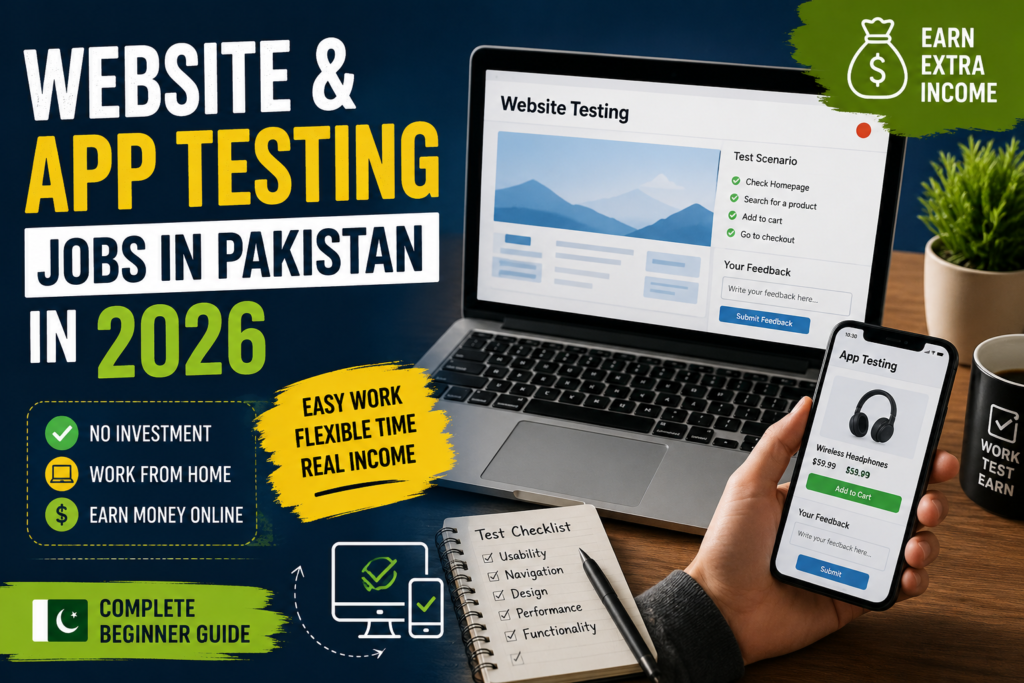
If you have a laptop, a stable internet connection, and the ability to explain what you think out loud, you can earn money testing websites and apps — without coding, without an audience, and without waiting months for your first client. Companies pay ordinary users to try their websites, find confusing buttons, and say what frustrates them, because one bad checkout page can cost a business thousands of customers.
In Pakistan, website testing is a realistic side income. It will not replace a full-time salary overnight, but it is one of the few online earning methods where beginners can get paid for short, clearly defined tasks. This guide explains how it works, which platforms accept Pakistani testers, what you actually earn, and how to pass the practice test that decides whether you get work.
What Is Website and App Testing?
Website testing, also called usability testing, means using a website or app exactly as a real customer would, while recording your screen and voice. You complete tasks such as finding a product, signing up, or completing a checkout, and you talk through what you see, what confuses you, and what you would change.
Companies do not want praise. They want honest reactions: “I cannot find the price,” “This button looks like an ad, not a button,” or “The form asked for too much information.” Your confusion is the product. That is why clear spoken English matters more than a fast computer or a fancy setup.
How Much Can You Earn Testing Websites in Pakistan?
Pay depends on the platform and the test length. As a realistic guide for 2026:
- A 5-minute quick test usually pays $3 to $5.
- A standard 15 to 20-minute test usually pays $10.
- A 30 to 60-minute live interview or moderated session can pay $30 to $90.
- Short surveys and screening questions usually pay $0.50 to $2, or nothing if you do not qualify.
Most beginners earn $30 to $150 per month in their first few months, because tests are not available every day and you will not qualify for every test. Testers who keep their profile updated, answer screeners honestly, and record clean audio tend to get more invitations over time. Treat this as flexible side income, not a guaranteed salary — and be suspicious of anyone promising hundreds of dollars per week from testing alone.
What You Need to Start
You do not need expensive equipment, but you do need a reliable setup:
- A laptop or desktop computer with Chrome or Edge installed.
- A microphone that records clear speech — a basic headset is usually better than a laptop microphone.
- A quiet room for recording, so background noise does not ruin your test.
- A stable internet connection fast enough for screen recording and video calls.
- A PayPal or Payoneer account for receiving payments, depending on the platform.
For mobile app tests, you will also need an Android or iPhone with enough free storage to install a recording app. Test the microphone and screen recorder before your practice test, not during it.
Legit Platforms That Accept Testers from Pakistan
Availability changes over time, and not every platform accepts testers from every country at all times. These are the best-known names to apply to first:
1. UserTesting
UserTesting is the largest and best-known platform. Tests usually pay $10 for a 20-minute session and more for live conversations. You complete a short practice test first; your rating from that test affects how many invitations you receive. Keep your profile complete and answer screeners carefully.
2. Userlytics and Trymata
These platforms run similar unmoderated tests — record your screen, follow the tasks, and speak your thoughts. Pay is usually per test rather than per hour, and tests arrive by email when your profile matches a study.
3. Maze and Userbrain
Maze focuses on quick prototype tests, often shorter and lower-paid, while Userbrain offers short tests with weekly payouts. These are good second and third platforms to join, because relying on one platform alone means quiet weeks with no work.
4. TestingTime and Respondent
These platforms specialise in longer, moderated interviews. They pay more, but they require a webcam, a quiet room, and a scheduled video call. They are a good next step once you are comfortable with short unmoderated tests.
Apply to several platforms at once. Create the same honest profile on each one — your age range, devices, job background, and the websites and apps you use regularly. Companies choose testers who match their target customers, so a complete profile is what gets you invited.
How to Pass the Practice Test
The practice test is the gatekeeper. Most rejections happen here, and most are avoidable:
- Talk constantly. Silence is the most common reason for failure. Narrate everything: what you clicked, what you expected, and what surprised you.
- Follow the task, not your own tour. If the task says “find a gift under Rs. 2,000,” do that task before exploring anything else.
- Be specific. Instead of “this is bad,” say “the checkout button is below the fold on my screen, so I scrolled past it twice before finding it.”
- Stay neutral and constructive. You can criticise a design, but stay polite and explain the problem and a possible fix.
- Check your audio before submitting. Record a 30-second test first. If your voice is faint, echoing, or drowned out by a fan, fix it before the real test.
If you fail a practice test, read the feedback carefully, fix the exact issue mentioned, and try again where the platform allows it. Do not create multiple accounts to get around a rejection — that can get you banned permanently.
Step-by-Step: Your First Week as a Tester
Day 1–2: Set up. Sign up on two or three platforms, complete your profile fully, and install any required recorder or browser extension. Test your microphone and screen recording.
Day 3: Record your practice test. Pick a quiet time, read the task twice, and record in one calm take. Speak slowly and clearly, and do not rush through tasks to finish early.
Day 4–7: Answer screeners daily. Check email and each platform dashboard once or twice a day. Answer screening questions honestly — inconsistent answers lead to rejected tests and lost pay.
Week 2 onward: Build your rating. Submit tests on time, follow instructions exactly, and keep your devices and profile information up to date. Testers with high ratings and fast response times get invited first.
Common Mistakes That Cost Testers Work
- Staying silent while completing tasks, so the client learns nothing from the recording.
- Rushing through a 20-minute test in five minutes, which usually leads to rejection.
- Giving only praise (“great website, easy to use”) with no detail or criticism.
- Testing in a noisy room or with a broken microphone.
- Exaggerating your profile to qualify for more tests — clients notice, and accounts get closed.
If a test is rejected, do not argue with the platform. Read the reason, learn from it, and do better on the next one.
How You Get Paid from Pakistan
Most testing platforms pay through PayPal, and some offer Payoneer or direct bank options. Before you invest hours, check each platform’s payment method and minimum payout. For a detailed comparison of payout routes, read our guide on how Pakistani freelancers actually get paid in 2026.
Keep a simple record of every test: platform, date, test length, expected pay, and payment date. If a payment is late, that record is what you will need for support. And because testing income is irregular, treat it as one income stream alongside other work — for example, the flexible remote roles in our virtual assistant guide or the AI-related roles covered in our data annotation and AI training jobs guide.
Is Website Testing Worth It in 2026?
Website testing is worth trying if you want paid, short, flexible work and you are comfortable speaking your thoughts aloud in English. It is not worth it if you need a fixed monthly salary, hate recording your voice, or cannot work in a quiet room. The honest middle ground is this: it is a genuine side income, it teaches you how real products are built, and it pairs well with freelancing — but it works best as one stream among several, not your only plan.
Before you apply anywhere, protect yourself the way you would with any online work: never pay a fee to join a testing platform, never share your passwords or banking login, and learn the warning signs in our guide to freelance scams in Pakistan. Legitimate platforms pay you; they never ask you to pay them.
Frequently Asked Questions
Do I need experience to test websites?
No. Companies want ordinary users, not designers or developers. Clear speech and honest reactions matter more than experience.
How long does a typical test take?
Most unmoderated tests take 10 to 20 minutes. Quick tests take about 5 minutes, and live interviews take 30 to 60 minutes.
Can I test websites on my phone?
Yes, for mobile app tests. Most platforms still offer more work on desktop, so a laptop gives you the most opportunities.
Why do I not qualify for many tests?
Clients choose testers who match a specific customer profile — age, location, device, or shopping habits. Not qualifying is normal, not a rejection of your ability.
Is website testing a scam?
Real platforms like UserTesting are legitimate businesses, but fake “testing jobs” that charge a joining fee are scams. Never pay to join.
Conclusion
Website and app testing is one of the simplest ways to start earning online from Pakistan: no clients to find, no portfolio to build, and no upfront investment beyond a headset and a quiet room. Sign up on two or three legitimate platforms, pass the practice test by thinking aloud clearly, and treat your first month as a learning period. The testers who earn consistently are not the fastest — they are the clearest, most honest, and most reliable voices in the room.
Start this week: complete your profiles, record a clean practice test, and answer screeners daily. Your first $10 test is closer than you think.
Premium Digital Products
If you want to turn testing into a wider freelance income, these resources can help you organise your work and win clients:
- Freelancer Business Kit ($14.99) — contracts, invoicing templates, and client systems for new freelancers.
- Ultimate Planner Bundle 2026 ($24.99) — planners to track tests, applications, payments, and weekly goals in one place.
Follow Us
- YouTube: AI Tool Hunter
- TikTok: https://www.tiktok.com/@aitoolhunter2
- Facebook: AI Tool Hunter