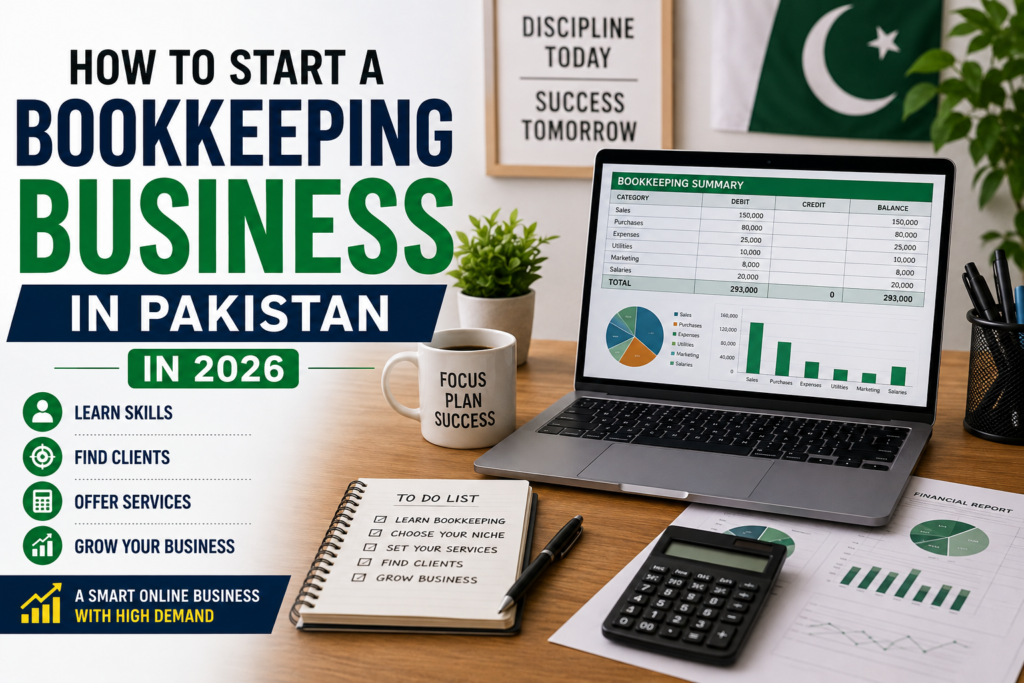
Remote Bookkeeping Jobs from Pakistan in 2026: Skills, Software and Client Trust
Every month, thousands of small businesses in the United States, the United Kingdom, Canada and Australia hand their invoices, receipts and bank statements to someone they have never met in person — and that someone increasingly sits in Lahore, Karachi, Islamabad or Faisalabad. Remote bookkeeping is one of the quietest remote careers coming out of Pakistan in 2026: it does not need a camera, a following or a portfolio of flashy designs. It needs accuracy, consistency and trust.
This is different from the general virtual assistant work we covered in our guide on how to become a virtual assistant in Pakistan in 2026. A virtual assistant handles a bit of everything. A bookkeeper owns one thing — the numbers — and owns it properly. That narrow focus is exactly why clients keep bookkeepers for years, while general help gets replaced. If you are good with detail, patient with messy spreadsheets and comfortable learning one or two software tools properly, this is a realistic remote career path to build from Pakistan.
A note on expectations before we start: this guide gives you the method, the skills and the steps. It does not promise a salary figure, because pay depends on the client, the workload, the currency and your experience. Any guide that quotes you a fixed monthly income for bookkeeping without naming a source is guessing. Here, worked examples are labelled as examples, and where a platform fee or rate changes often, you are told to confirm the current number inside your own account.
What a Remote Bookkeeper Actually Does
A bookkeeper records the financial transactions of a business so the owner — and their accountant — can see clearly what came in, what went out and what is owed. Day to day, that usually means:
- Recording sales invoices and supplier bills
- Matching bank and card transactions to the right category (called bank reconciliation)
- Tracking who owes the business money (accounts receivable) and who the business owes (accounts payable)
- Preparing simple monthly reports: profit and loss, and a summary of cash in and out
- Keeping receipts, invoices and statements organised so tax time is not a panic
You are not the accountant. The accountant files taxes and gives tax advice. The bookkeeper keeps the records clean so the accountant’s job is possible. That distinction matters, because it also lowers the barrier to entry: you do not need a chartered accountancy qualification to start bookkeeping for small businesses. You need training in the basics, practice on sample data and proof that you are accurate.
Most remote bookkeeping clients are small businesses: e-commerce sellers, agencies, coaches, clinics, restaurants and trades businesses with 1–20 staff. They cannot justify a full-time in-house bookkeeper, so they hire a remote bookkeeper for a few hours a week or a fixed monthly package. That is why this work suits Pakistan’s freelance economy so well — the same shift toward monthly retainers we described in Specialization + Proof of Work: The 2026 Playbook for New Pakistani Freelancers applies here better than almost anywhere else.
The Skills You Actually Need (and the Ones You Don’t)
1. Double-entry basics and the chart of accounts
Bookkeeping rests on one idea: every transaction has two sides. When a business sells something, cash (or a receivable) goes up and income goes up. When it pays rent, cash goes down and an expense goes up. You do not need to memorise accounting theory, but you do need to be comfortable with debits, credits and the chart of accounts — the list of categories (sales, rent, software subscriptions, supplies, salaries) that every transaction gets sorted into.
Free starting points exist in Pakistan. DigiSkills, Pakistan’s free government training programme, offers accounting and freelancing tracks that teach these foundations — see our guide on DigiSkills 2026: Pakistan’s free government courses that actually lead to income. A single DigiSkills course will not make you a bookkeeper on its own, but paired with hands-on practice in real software, it is a strong, free foundation.
2. Accuracy under boredom
This is the skill clients test first, even if they never name it. Bookkeeping is repetitive by design: the same reconciliations, every week, every month. The bookkeepers who keep clients are the ones whose work matches to the rupee — or the dollar — the tenth time as well as the first. If you enjoy spotting a 500-rupee mismatch and will not rest until you find it, you have the temperament. If you rush and hope small errors go unnoticed, clients will notice before you do.
3. Clear, professional English communication
Your clients will mostly write to you in English, and most of your value is in the short messages around the numbers: “Three transactions are unmatched — I need the receipt for the 12 October software charge.” Short, clear, polite English beats long, flowery English every time. You do not need a perfect accent for this work, because almost all of it is written.
4. Confidentiality
You will see a client’s bank activity, supplier prices and payroll. Treating that information as strictly private is not optional — it is the whole basis of trust. Never share a client’s figures, even anonymised, without permission. Clients hire bookkeepers they trust with money information; one careless screenshot ends that trust permanently.
What you do not need: a degree in accounting, prior work at a firm, or advanced maths. Bookkeeping software does the arithmetic. Your job is judgement — which category, which account, which document proves it.
The Software Clients Actually Ask For
Clients rarely ask for a certificate. They ask: “Do you know QuickBooks?” or “Can you work in Xero?” Learn one tool deeply before collecting certificates in five. The table below compares the tools Pakistani remote bookkeepers are most commonly asked about in 2026.
| Software | Who uses it | What to learn first | Notes for beginners in Pakistan |
|---|---|---|---|
| QuickBooks Online | Small businesses in the US, UK and Canada; the most commonly requested tool | Invoicing, bank feeds, reconciliation, chart of accounts, monthly reports | The industry default — if you learn one tool, learn this one. Free practice options and sample companies exist for learners; confirm the current trial terms inside your own account before signing up. |
| Xero | UK, Australian and New Zealand small businesses; growing among agencies | Bank reconciliation, invoicing, expense claims, payroll add-ons | Strong second tool, especially if you target UK or Australian clients. Its interface is cleaner for beginners, but client demand from Pakistan-based hiring is smaller than QuickBooks. |
| Wave | Very small businesses and solo freelancers on a tight budget | Invoicing, receipt uploads, basic reports | Free tier appeals to tiny clients, but fewer paying clients use it, so treat it as a bonus skill, not your main one. |
| Microsoft Excel / Google Sheets | Almost every client, alongside one of the above | Clean data entry, formulas (SUM, VLOOKUP/XLOOKUP, pivot tables), tidy monthly trackers | Non-negotiable. Even QuickBooks clients will send you a spreadsheet. Messy spreadsheets are the number one reason beginners lose a trial task. |
A practical learning order: Excel basics first, then QuickBooks Online on a sample company, then Xero basics. That sequence covers the majority of job posts and freelance listings. YouTube tutorials and the software makers’ own free training (QuickBooks ProAdvisor training, Xero advisor certification) are the standard free routes — complete the training, then practise on invented data until a full month reconciles cleanly.
A Pakistan-Specific Example: From DigiSkills Student to Monthly Retainer
Consider a realistic path, based on the pattern behind many Pakistani freelancers’ first retainers rather than one named person’s story. Ayesha, a commerce graduate in Faisalabad, completes a free DigiSkills accounting course and spends four weeks practising in QuickBooks Online’s sample company, reconciling invented bank statements until every month balances. She then offers two local businesses — a small online store and a tuition academy — one free month of bookkeeping in exchange for a written testimonial and permission to show anonymised before-and-after reports (messy records in, clean monthly summary out).
Those two pieces of proof — not a certificate — win her first paying client, a UK-based e-commerce seller found through a freelance platform. The work starts as a trial: reconcile one month of transactions. It goes well, so it becomes a fixed monthly package: weekly transaction categorisation, a monthly profit-and-loss summary and a short email flagging anything unusual. Within six months the pattern repeats with a second client, and her income is two monthly retainers instead of a string of one-off gigs.
The lesson is not that this happens quickly — allow 30 to 90 days of daily effort before the first paying client, as we set out in How Long Until Your First Client? A Realistic Freelancing Timeline in Pakistan — but that proof beats promises. A client choosing between ten applicants picks the one who can show a clean sample month, not the one with the longest profile description.
How Beginners Prove Accuracy Before Handling Real Books
No sensible client hands live bank access to a stranger. Expect a trial, and prepare for it:
- Build a sample month. Invent a small business — say, a Lahore-based online store with 40 transactions: sales, courier fees, packaging, ads, a refund and one unmatched bank charge. Record it all in QuickBooks or a spreadsheet, reconcile it, and produce a one-page profit-and-loss summary. This is your portfolio piece.
- Show your checks, not just your totals. A good sample includes a short note: “Bank balance per statement: X. Balance per books: X. Difference: zero. Two receipts were missing and are listed here.” Clients hire the person who finds the gap, not the person who hides it.
- Offer a paid trial month first. A one-month paid trial, priced as a single project, is easier for a client to say yes to than an open-ended retainer. Do excellent work in that month, and the retainer conversation happens naturally.
- Never practise on a real client’s live books while learning. If you are still unsure about a category or a reconciliation step, practise on sample data first, or ask the client’s accountant. Guessing inside live books is how errors — and lost clients — happen.
This proof-first approach also protects you from the scam patterns we covered in Freelance Scams in Pakistan: 7 Red Flags and How to Say No Without Losing Real Clients — a genuine client will accept a trial and a contract; a scammer will push for free work or off-platform payment before any work exists.
Pricing Your Work: Method, Not a Quoted Rate
Bookkeeping is usually priced as a monthly package based on transaction volume, not an hourly rate — a business with 30 transactions a month is a smaller job than one with 300. The method beginners can use:
- Count the work. Ask the client: how many bank transactions per month, how many invoices, how many suppliers, and whether payroll is included. That count decides the package size.
- Estimate your hours honestly. Time yourself on your sample month. If a 50-transaction month takes you four hours, that is your baseline — not a guess.
- Add a buffer for questions and corrections. Clients ask questions. Statements arrive late. Build in time for that instead of discovering it after you quoted.
- Quote the package, state what is included, and set revision limits. “Monthly bookkeeping up to 100 transactions, weekly categorisation, one monthly report, two revision rounds” is a quote a client can accept. An open-ended “I will do your accounts” is not.
Worked example (labelled as an example, not a market rate): if a 60-transaction month takes you five hours and you decide your time is worth a certain hourly figure, your monthly package is five times that figure plus a buffer for queries. Change any input and the package changes — that is the point. For the full method, see How to Price Your First Freelance Service in PKR: Hourly, Project and Retainer Math. And when you are paid, use a proper route and keep records — our comparison of how Pakistani freelancers actually get paid in 2026 covers Payoneer, Wise and bank transfer.
Getting Paid and Staying Compliant
Keep your own records as carefully as you keep your clients’. Issue an invoice for every month, keep a copy of every payment receipt, and keep client work and personal money in separate records. Pakistan’s freelancer tax regime — the 0.25% final tax covered in our 2026 registration, filing and invoicing guide — is worth reading before your first payment arrives, not after. Confirm the current rules with a tax professional for your own situation; this article is a starting guide, not tax advice.
Common Beginner Mistakes to Avoid
- Mixing personal and business spending in the books. If a transaction is not the business’s, it does not go in the business’s books — flag it and ask.
- Categorising by guesswork. “Miscellaneous” is not a category for half the transactions. If you are unsure, ask the client or check the receipt.
- Leaving reconciliations for month-end. Reconcile weekly. A mismatch found this week is a five-minute fix; the same mismatch found three months later is an afternoon of detective work.
- Working without a written scope. Even a one-page agreement — what is included, how many transactions, when the report arrives, how payment works — prevents most disputes. See also the scams guide linked above for red flags to watch for before you sign anything.
- Taking on payroll or tax filing before you are ready. Payroll and tax have legal consequences. Decline that part of the work until you are trained for it, and say so honestly — clients respect a clear boundary more than a confident mistake.
Your 30-Day Starter Plan
- Week 1: Finish the accounting basics (DigiSkills or an equivalent free course) and set up QuickBooks Online’s sample company.
- Week 2: Build your sample month — 40 to 60 invented transactions, fully reconciled, with a one-page profit-and-loss summary.
- Week 3: Write your service offer: what is included, transaction limits, monthly package structure, and a one-month paid trial. Create profiles on one or two freelance platforms, leading with the sample month.
- Week 4: Apply to five suitable listings a day, and approach two local businesses for a testimonial month. Track every application and follow up once, politely, after a week.
You will not be an expert in 30 days. You will be ready for a trial — and a trial is all a first client needs to see.
Frequently Asked Questions
Do I need an accounting degree to become a remote bookkeeper?
No. Small-business clients hire on demonstrated accuracy in QuickBooks or Xero and a clean sample month. A degree helps for larger firms and for moving into accounting later, but it is not the entry requirement for freelance bookkeeping.
How is bookkeeping different from virtual assistant work?
A virtual assistant handles varied admin tasks. A bookkeeper owns the financial records specifically — categorisation, reconciliation and monthly reports. The narrower focus is why bookkeeping retainers last longer and pay more steadily than general admin work.
Which software should I learn first?
QuickBooks Online, because it is the most commonly requested by US, UK and Canadian small businesses. Add Xero second if you want UK or Australian clients, and keep Excel sharp throughout — every client uses spreadsheets alongside their accounting tool.
How long before I get my first paying client?
Plan for 30 to 90 days of daily effort: learning, building a sample month, applying and following up. Anyone promising a client in a week is selling a course, not describing the market.
Is bookkeeping work available year-round?
Yes — businesses need monthly books every month, not just at tax time. That regularity is the main advantage over project-based freelance work: a retained client is income you can plan around.
Do I need to handle my clients’ taxes?
No. Bookkeeping and tax filing are separate jobs. Keep the records clean, and the client’s accountant handles tax. Do not offer tax advice unless you are qualified to give it.
Premium Digital Products
If you are building a freelance career around a skill like bookkeeping, these resources can speed up the business side — templates, prompts and planners that save you from starting every document from scratch:
- Freelancer Business Kit ($14.99) — contracts, invoicing and client-management templates for new freelancers.
- Ultimate Planner Bundle 2026 ($24.99) — planners to organise your client work, deadlines and monthly reporting rhythm.
- Content Creator Planner 2026 ($12.99) — useful if you also document your bookkeeping journey or build a professional presence online.
Conclusion
Remote bookkeeping from Pakistan in 2026 is not a shortcut and it is not a get-rich-quick scheme. It is a steady, learnable trade: learn the basics, master one software tool, prove your accuracy on a sample month, and turn a paid trial into a monthly retainer. Clients do not need you to be extraordinary. They need you to be accurate, consistent and trustworthy with their numbers — month after month. Start with the 30-day plan above, build the sample month this week, and let proof, not promises, win your first client.
Follow Us
- YouTube: AI Tool Hunter
- TikTok: @aitoolhunter2
- Facebook: AI Tool Hunter