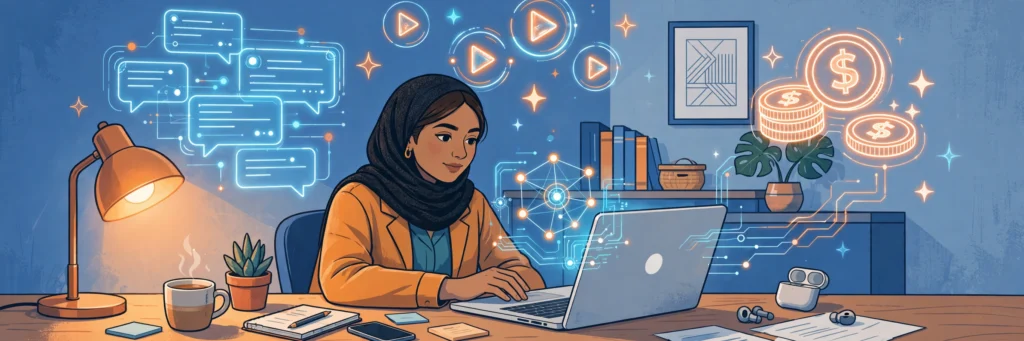
AI art tools can now create posters, wall art, phone wallpapers and t-shirt designs in minutes. The opportunity for creators in Pakistan is real — but it is not a “press a button and get rich” trick. Buyers pay for taste, curation and presentation, not for raw AI output. This guide shows how to turn AI-generated art into a steady side income in 2026.
Who Buys AI-Generated Art?
AI art is artwork created with tools like Midjourney, DALL-E, Leonardo AI and Ideogram, guided by text prompts. Buyers rarely care which tool you used. They care whether the image looks good on their wall, their phone or their product.
The main buyers are home decor shoppers buying printable wall art, small business owners who need logos and social media graphics, print-on-demand customers buying designs on t-shirts and mugs, and creators who need thumbnails and book covers.
The market is crowded, so winners pick a clear niche — Islamic geometric art, minimalist line art, Pakistani truck-art-inspired designs, or aesthetic bedroom posters — and build a consistent style around it.
Step 1: Pick a Profitable Niche
Do not try to sell “everything”. A focused shop sells better than a scattered one. Good niches for 2026 include printable wall art, phone and desktop wallpapers, t-shirt and mug designs, book covers, and kids’ room art such as cute animals and alphabet posters.
Check demand first: search your niche on Etsy and Pinterest, look at the bestsellers, and note the styles, colours and prices that repeat. If the top results all look the same, the niche sells — your job is to make a better, more original version, not a copy.
Step 2: Create Art That Actually Sells
Generating an image is easy. Making it sellable takes more work:
- Write detailed prompts. Instead of “a cat”, try “a watercolour painting of a ginger cat sleeping on a windowsill, soft morning light, muted colours, cozy and calm”.
- Generate in batches, then curate hard. Create 50 images and keep the best 5. Most AI output is average; your taste is the product.
- Upscale and clean up. Upscale to print quality — at least 300 DPI at the size you sell — and remove warped text or distorted faces.
- Build sets, not singles. A set of 3 matching posters sells better than one random image and justifies a higher price.
- Keep a consistent style. When a buyer likes one piece, they should recognise your other work instantly.
Many sellers pair AI image tools with Canva to add typography and mockups. If you are new to Canva as an income tool, our guide on how to earn money with Canva in Pakistan covers the basics.
Step 3: Choose Where to Sell
You do not need your own website to start. These platforms work from Pakistan:
Etsy — best for printable wall art. The largest marketplace for digital downloads: you list a digital file, the buyer downloads it, and you never ship anything. Read our guide on how to sell digital products on Etsy from Pakistan before opening a shop, because payment setup needs care.
Gumroad — best for bundles and your own audience. Sell directly to followers with no per-listing fees. It works well for wallpaper packs, prompt bundles and design collections.
Print-on-demand — best for physical products. Platforms like Printful, Redbubble and TeePublic print your designs on t-shirts, mugs and posters and ship them for you. You earn a margin on each sale with no inventory. Our print-on-demand guide for Pakistan explains the model.
Stock sites — best for passive income. Adobe Stock and Dreamstime accept AI images if you label them correctly. Earnings per download are small, but a large portfolio adds up.
Start with one platform and do it well. Add a second channel only once the first one is making regular sales.
Step 4: Price Your AI Art Realistically
Realistic 2026 starting points: a single printable poster $3–$8, a set of 3–5 matching posters $8–$15, a phone wallpaper pack of 10 images $2–$5, a commercial-use licence 2–3x the personal-use price, and a print-on-demand t-shirt $5–$10 profit per sale after platform costs.
Do not price at $0.99 hoping for volume — you will work hard for almost nothing. A small number of sales at fair prices beats hundreds of near-free downloads.
Step 5: Get Paid from Pakistan
Payoneer is the standard route for Etsy and most marketplaces; you withdraw to your local bank account in PKR. Wise works for some platforms and direct client payments. Gumroad pays out via PayPal or bank transfer depending on your setup — check the current payout options before committing to it as your main channel.
Keep a simple record of every sale: date, platform, amount and payout. You will need it for tax filing, and it shows which products actually earn. Our guide on how Pakistani freelancers actually get paid in 2026 compares Payoneer, Wise and bank transfer in detail.
Copyright and Platform Rules You Must Know
Read each tool’s commercial terms: most paid plans allow commercial use, while free plans often do not. Never sell images of real people, celebrities or trademarked characters — selling them can get your shop banned. Disclose AI use where the platform requires it; Etsy and Adobe Stock both have AI disclosure rules, and hiding it risks suspension. Do not copy another seller’s style or prompt word-for-word. Keep your prompts and source files — if a platform ever questions a listing, your original files are your proof of work. A single policy strike can close a shop you spent months building.
How Much Can You Realistically Earn?
AI art is not instant income. In month one, build 30–50 quality listings and expect few or no sales while the shop is new. In months two and three, first sales trickle in — $20–$100 per month is a good early result. By months four to six, with 100+ listings and some bestsellers, $100–$300 per month is achievable for a consistent seller. After six months, sellers who keep adding designs, test new niches and promote on Pinterest can grow beyond that — but it depends on quality, consistency and marketing, not luck.
5 Mistakes That Kill New AI Art Shops
- Uploading raw, unedited AI output. Blurry hands, gibberish text and low resolution get bad reviews fast.
- Copying bestselling designs. Platforms remove copies, and buyers report them.
- No mockups. A poster on a blank white background sells far worse than the same poster in a styled room.
- Ignoring SEO. Titles and tags are how buyers find you — use the words buyers actually search, like “boho wall art printable”.
- Quitting after two weeks. New shops need time to be indexed and trusted. Most sellers quit just before their first sales arrive.
Premium Digital Products
If you want to move faster, these ready-made resources can help you build your own art and content business:
- Wall Art Print Bundle ($14.99) — a ready-to-use collection of printable wall art designs to study, customise and learn from: https://umar2023.gumroad.com/l/wwgxe
- AI Prompt Mega Bundle ($29.99) — hundreds of tested prompts for AI image tools, so you can generate better art with less trial and error: https://umar2023.gumroad.com/l/whthnh
- 100 Viral Content Prompts ($9.99) — prompts to promote your art shop on TikTok, Instagram and Pinterest and bring in buyers: https://umar2023.gumroad.com/l/rnzhgv
Use them as a starting point and a learning shortcut — your own style and curation are still what make the shop yours.
Frequently Asked Questions
Is selling AI-generated art legal in Pakistan?
Yes, as long as you follow the AI tool’s licence terms and do not infringe on trademarks or real people’s likeness. Keep sales records for tax purposes.
Do I need a paid AI tool to sell the art?
In most cases, yes. Paid plans of tools like Midjourney and Leonardo AI include commercial use rights. Free plans usually restrict commercial use, which makes selling that art risky.
How many designs do I need before I start earning?
Most sellers see their first sales after 30–50 quality listings. Shops with 100+ listings earn more consistently because they appear in more searches.
Can I sell AI art on Etsy from Pakistan?
Yes. Etsy allows AI-generated art if you disclose it in the listing. You will need to sort out payment through Payoneer, as covered in our Etsy guide linked above.
Is the AI art market too saturated in 2026?
The generic market is crowded, but specific niches are not. Sellers who pick a clear style, a clear audience and high-quality mockups still find buyers. Saturation punishes copycats, not original sellers.
Conclusion
Selling AI-generated art from Pakistan in 2026 is a real, low-cost way to earn online — if you treat it as a craft and a business. Pick one niche, create art people actually want on their walls, list it properly with good mockups and honest disclosure, and keep adding to your shop every week. The tools make the images; your taste, consistency and patience make the income.
Start today: generate ten images in one niche, keep the best three, and list them. That first listing is the hardest part — everything after it is just repetition.
Follow Us
- YouTube: https://youtube.com/@aitoolhunter-l3x (AI Tool Hunter)
- TikTok: https://www.tiktok.com/@aitoolhunter2
- Facebook: https://www.facebook.com/share/1BSSJwLtas/ (AI Tool Hunter)